
ERC-7838
EIP | Instruction Specific Address (ISA)

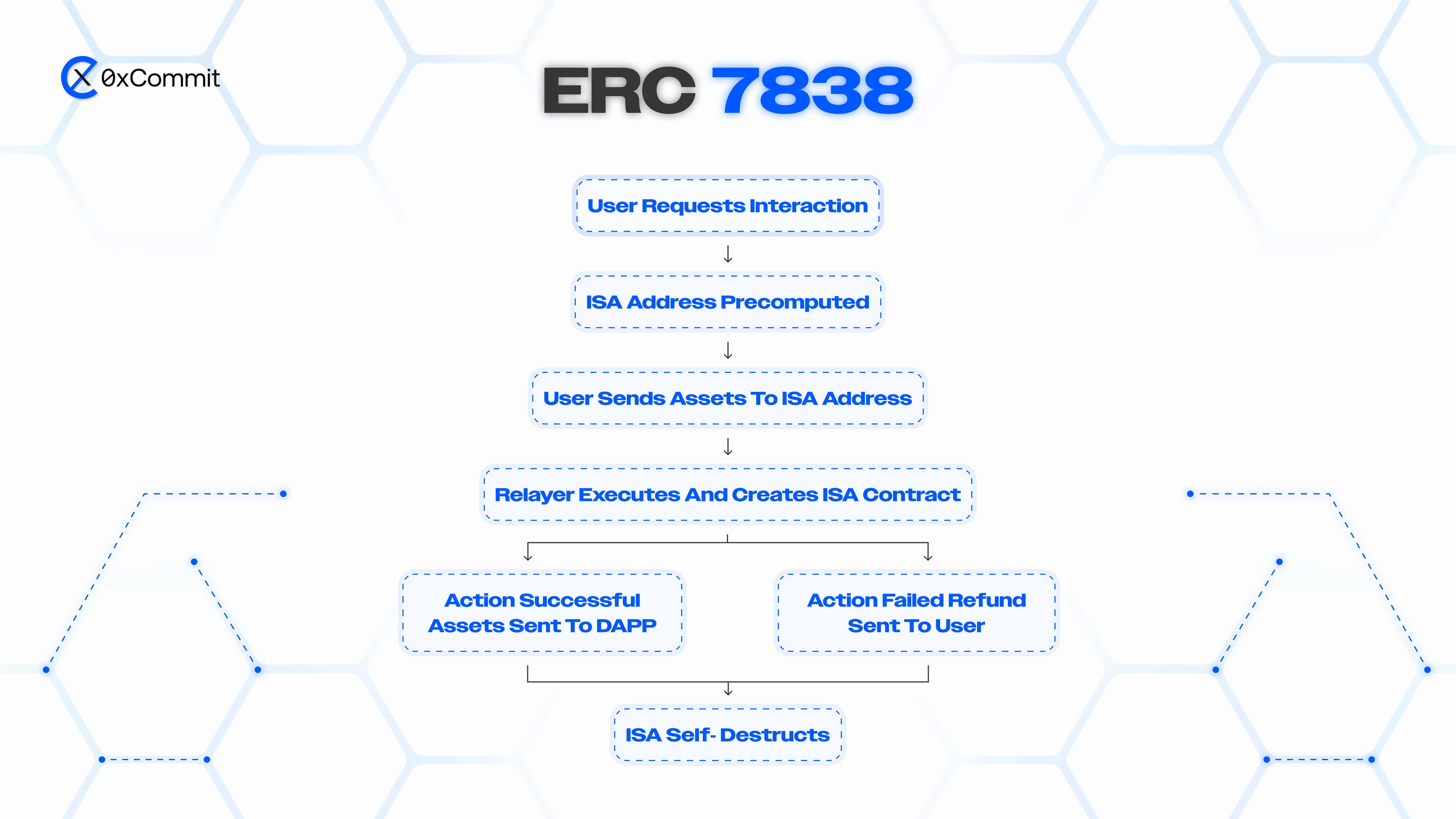
Introduction to ERC-7838
This EIP introduces the Instruction Specific Address (ISA) mechanism, a novel approach to user interaction with decentralized applications (DApps). ISA allows for approval-less transactions by generating dynamic, single-use addresses for each interaction. This eliminates the need for upfront wallet connections or approvals, significantly enhancing user security and simplifying DApp usage.
ERC-7838 aims to bridge the usability gap between centralized and decentralized applications, driving wider adoption of Web3 technologies by providing a more secure, user-friendly, and efficient way to interact with DApps.
Addressing the Security Challenges of Web3 User Interaction
The current Web3 interaction model, characterized by complex wallet connections, approvals, and transaction signing, presents significant security challenges that hinder mainstream adoption:
Phishing and Social Engineering: Connecting wallets to DApps exposes users to phishing attacks. Malicious actors can mimic legitimate DApp interfaces to trick users into approving unauthorized transactions or revealing their private keys.
Smart Contract Vulnerabilities: Even with reputable DApps, vulnerabilities in smart contracts can be exploited. Blanket approvals for tokens or assets further amplify the risk, as attackers can drain user funds if a vulnerability is found.
Limited User Control: Users often face complex approval prompts with technical jargon, making it difficult to understand the implications of their actions. This lack of transparency can lead to unintended consequences and security breaches.
Instruction Specific Addresses (ISA) offer a robust solution to these challenges by:
Isolating User Wallets: ISA detaches wallets from direct DApp interaction, preventing malicious DApps from accessing sensitive information or exploiting vulnerabilities. Each interaction uses a unique, temporary ISA, limiting the potential impact of any security breach.
Eliminating Blanket Approvals: ISA enables approval-less transactions, meaning users only authorize the specific amount required for a given interaction. This granular control significantly minimizes the risk of unauthorized access to user funds.
Enhancing User Understanding: By simplifying the interaction flow and removing technical complexities, ISA empowers users to make informed decisions about their actions and associated risks.
Understanding Key Concepts in ERC-7838
Here's a breakdown of the core components that enable the secure and efficient functionality of Instruction Specific Addresses:
Instruction Specific Address (ISA): This is the heart of ERC-7838. Think of it as a temporary, single-use "mini-contract" generated for each unique DApp interaction. It enhances security by isolating the user's main wallet from the DApp and limiting the scope of each transaction.
CallOps: This standardized structure defines the instructions for the ISA. It acts like a secure message format, ensuring all parties involved (user, relayer, DApp) understand the precise details of the interaction.
Relayer: Relayers are essential intermediaries that execute the ISA operations on behalf of the user. They handle the technical complexities of generating ISAs and interacting with the blockchain, making the process seamless for the user.
RefundRecipient: This address, designated by the user, adds another layer of security. If an interaction fails for any reason, any funds associated with the ISA are automatically returned to the RefundRecipient, preventing loss or unexpected behavior.
TargetAddress: This is simply the address of the DApp contract that the user intends to interact with.
ApprovalAddress: In scenarios where token approvals are necessary (e.g., spending an ERC-20 token), this address manages the approval process, ensuring security and control.
Understanding these components is crucial for grasping the full potential of ERC-7838 in enhancing both the security and usability of Web3 interactions.
Decoding the CallOps Structure: The Blueprint for Secure ISA Interactions
To ensure compatibility and smooth operation across different platforms, ERC-7838 relies on a standardized structure called CallOps. Think of it as the blueprint that defines all the essential parameters for each ISA interaction. Here's a breakdown of its core elements:
/// @title CallOps Structure
/// @notice Defines the parameters for executing an ISA operation
struct CallOps {
   /// @dev The target contract address for the operation
   address targetAddress;


   /// @dev Address responsible for approving token transfers, if applicable
   address approvalAddress;


   /// @dev Encoded data for the transaction to execute
   bytes executionData;


   /// @dev The token being transferred (use address(0) for native assets)
   address sourceToken;


   /// @dev Address to receive refunds in case of failed interaction
   address refundRecipient;


   /// @dev Address of the relayer responsible for execution
   address relayerAddress;


   /// @dev Fee paid to the relayer for execution
   uint256 relayerFee;
}
targetAddress: This specifies the destination DApp contract for the interaction.
approvalAddress: If the interaction involves tokens, this field designates the address authorized to approve the necessary token transfers. This adds a layer of security by controlling token access.
executionData: This contains the encoded instructions for the transaction, specifying the desired action on the target contract.
sourceToken: This indicates the token involved in the transaction. Using address(0) signifies the use of the blockchain's native asset (e.g., ETH).
refundRecipient: A crucial security feature, this address receives any funds if the interaction fails. This prevents loss of funds due to errors or unexpected behavior.
relayerAddress: This identifies the relayer responsible for executing the ISA operation.
relayerFee: This specifies the fee paid to the relayer for their services.
By adhering to this standardized CallOps structure, ERC-7838 ensures consistent and interoperable ISA interactions, simplifying integration for developers and promoting a secure and reliable user experience.
Predictable Security: ISA Address Generation with CREATE2
ERC-7838 leverages the CREATE2 opcode for deterministic ISA address generation. This means that given the same inputs, the generated address will always be identical, regardless of the blockchain's state or who performs the calculation. This determinism is crucial for security and compatibility across different applications and ecosystems.
Here's how it works within the ISAFactory contract:
/// @title ISAFactory Contract
/// @notice Generates deterministic ISA addresses using CREATE2
contract ISAFactory {
   function generateAddress(
       bytes32 salt,
       bytes memory initializationCode
   ) public view returns (address) {
       return address(uint160(uint256(
           keccak256(
               abi.encodePacked(
                   hex"ff",
                   address(this),
                   salt,
                   keccak256(initializationCode)
               )
           )
       )));
   }
}
By employing CREATE2, ERC-7838 strengthens the security and reliability of ISA interactions, paving the way for a more trustworthy and user-friendly Web3 experience.
Enhancing Transparency and Security with ISA Events
Transparency is paramount in blockchain interactions. ERC-7838 mandates the emission of specific events to provide a clear audit trail of ISA operations, enhancing both security and user trust. These events act as signals, broadcasting key state transitions and offering valuable operational feedback.
Here's a breakdown of the events and their significance:
/// @notice Emitted upon successful execution of the ISA
/// @param targetAddress The target contract address
/// @param amountTransferred The amount of tokens or assets transferred
event ExecutionSucceeded(address indexed relayerAddress, address indexed targetAddress, uint256 amountTransferred);


/// @notice Emitted when an ISA execution fails
/// @param targetAddress The target contract address
/// @param reason The reason for failure
event ExecutionFailed(address indexed relayerAddress, address indexed targetAddress, string reason);


/// @notice Emitted when a refund is issued to the specified recipient
/// @param refundRecipient The address receiving the refund
/// @param amount The amount refunded
event RefundIssued(address indexed refundRecipient, uint256 amount);
ExecutionSucceeded: This event confirms a successful ISA interaction, providing details like the targetAddress and the amountTransferred. This allows users and developers to track successful operations and verify the correct execution of instructions.
ExecutionFailed: If an ISA operation fails, this event provides crucial debugging information. It includes the targetAddress and a reason for the failure, aiding in troubleshooting and identifying potential issues. This transparency helps to pinpoint errors and improve the reliability of ISA interactions.
RefundIssued: This event signals that a refund has been issued to the designated refundRecipient. It includes the recipient's address and the amount refunded. This ensures users can track refunds and adds a layer of accountability to the ISA process.
By mandating these events, ERC-7838 contributes to a more secure and transparent Web3 environment, where users can confidently engage in DApp interactions with a clear understanding of the underlying processes.
The Lifecycle of an ISA Interaction: A Secure and Streamlined Process
Instruction Specific Addresses (ISAs) streamline and secure DApp interactions by following a well-defined lifecycle. Here's a breakdown of the key stages, emphasizing the security considerations at each step:
1. Address Creation:
User Request: The user initiates an interaction with a DApp, providing the necessary parameters (e.g., desired action, amount, target contract).
Deterministic Generation: The ISAFactory contract utilizes the CREATE2 opcode to generate a unique, predictable ISA address based on the provided parameters. This determinism is crucial for security, as it allows for independent verification of the address and prevents address manipulation.
2. Asset Transfer:
Secure Transfer: The user transfers the required assets (tokens or native currency) to the generated ISA address. This isolates the user's main wallet from the DApp, minimizing the risk of exposure to vulnerabilities.
3. Execution:
Controlled Execution: The ISA, acting as a temporary, single-use contract, executes the transaction based on the predefined CallOps parameters. This ensures that the interaction adheres to the intended instructions and limits the scope of the transaction.
Success or Failure: If the execution is successful, the target DApp receives the assets and performs the specified action. If it fails (e.g., due to an error in the DApp or insufficient funds), the ISA proceeds to the refund mechanism.
4. Refund Mechanism:
Automated Refund: In case of failure, the ISA automatically refunds the remaining assets to the user-specified refundRecipient address. This prevents loss of funds and ensures user control even in unexpected situations.
5. Self-Destruction:
Resource Optimization: After successful execution or refund, the ISA self-destructs. This frees up blockchain resources and ensures that the ISA cannot be reused, further enhancing security by preventing replay attacks or unauthorized access.
Security Advantages of this Lifecycle:
Reduced Attack Surface: Isolating the user's wallet and using single-use ISAs minimizes the potential attack surface for malicious actors.
Granular Control: Users maintain control over their assets throughout the process, only authorizing specific actions and amounts.
Enhanced Transparency: The deterministic address generation and event emissions provide a clear audit trail, allowing for easy tracking and verification of interactions.
Fail-Safe Mechanism: The refund mechanism ensures that users are protected from losing funds due to errors or malicious DApps.
By following this secure and streamlined lifecycle, ERC-7838 enhances the overall security and user experience of Web3 interactions, promoting wider adoption of decentralized technologies.
Why ISAs are a Critical Advancement for Web3 Security and Adoption
Instruction Specific Addresses (ISAs) address the critical challenges hindering widespread Web3 adoption by enhancing security, simplifying user experience, and promoting interoperability. Here's a breakdown of the core rationale behind this innovative approach:
1. Approval-less Interactions: A Paradigm Shift in Security
Traditional DApp interactions require users to grant blanket approvals for tokens, exposing them to significant risks. ISAs eliminate this vulnerability by enabling direct, approval-less interactions, mitigating several key threats such as Phishing Attacks, Wallet Tunneling, Approval-Based Risks.
2. Security Enhancements: Minimizing Risk Exposure
ISAs prioritize security by design, incorporating features that minimize user risk and promote trust:
Limited Capital at Risk: The maximum funds a user can lose in an ISA interaction is limited to the amount specifically transferred to the ISA for that transaction.
Refund Mechanisms: ISAs guarantee refunds for any unspent or unused assets in case of transaction failures, protecting users from unexpected losses.
3. Interoperability and Extensibility
ISAs are designed for a multi-chain future, promoting interoperability and flexibility:
Blockchain Agnosticism: ISAs are compatible across diverse blockchain ecosystems, ensuring no reliance on specific protocols or networks.
Relayer Flexibility: The standardized CallOps structure enables compatibility with various relayer networks, fostering competition and innovation in the relayer space.
Protocol Neutrality: ISAs focus on universal interaction standards and remain independent of any specific bridging or routing protocols.
4. Handling Edge Cases with Grace
ISAs incorporate mechanisms to handle potential failure scenarios and maintain system integrity:
Data Availability Layers: To prevent issues arising from lost data used for address generation, ISAs can leverage data availability (DA) layers. These layers ensure the persistence and retrievability of crucial data, even in adverse conditions.
Refund Fallbacks: If the specified refundRecipient address is incorrect or unreachable, the ISA automatically reverts the refund to the sender. This fail-safe mechanism prevents the loss of user funds due to address errors.
5. Aligning with Payment and Product Philosophies
ISAs promote a user-centric approach that prioritizes action and seamless experiences:
Action-First Approach: ISAs encourage users to engage with DApp functionality directly, removing the initial barrier of "connect wallet." This streamlines the user journey and aligns with intuitive payment flows.
Unified Chain Experience: By decoupling wallet requirements, ISAs create a consistent experience across different blockchain platforms. This simplifies cross-chain interactions and promotes a unified Web3 experience.
6. Compatibility with Existing Standards
ISAs are designed to integrate smoothly with existing Ethereum standards and infrastructure:
EIP-7683 (Cross-Chain Intents): ISAs support interaction paradigms that abstract user intent across different chains, aligning with the goals of EIP-7683 for seamless cross-chain communication.
Broad Compatibility: ISAs maintain a protocol-agnostic approach, ensuring compatibility with future standards and promoting flexibility in a dynamic ecosystem.
Security Considerations for ISAs: A Shared Responsibility Model
While ERC-7838 provides a robust framework for secure interactions, it intentionally remains agnostic about the specific implementation details of ISA contracts. This design choice allows for flexibility and adaptability across different use cases and ecosystems. However, it also places a crucial responsibility on developers and integrators to ensure the security of their ISA implementations.
Here's a refined breakdown of the key security considerations:
1. Evaluating ISA Contract Security
Auditing is Crucial: Developers must prioritize thorough audits of their ISA contracts to identify and mitigate potential vulnerabilities. This includes scrutinizing the entire lifecycle of the ISA, from creation and execution to self-destruction.
Relayer Integrity: The security of the ISA ecosystem relies heavily on the integrity of relayers. Developers must ensure that relayers adhere to the CallOps structure and follow secure coding practices.
Event Observability: Leveraging the event emission mechanism is crucial for monitoring ISA operations and detecting suspicious activities. Developers should implement robust monitoring and alerting systems based on these events.
2. Leveraging Deterministic Address Generation
Uniqueness and Immutability: Developers must ensure that the initialization parameters used for CREATE2 (salts and bytecode) are unique and immutable to prevent address collisions and potential security breaches.
Secure Parameter Generation: The process of generating these parameters should itself be secure and resistant to manipulation.
3. Safeguards Against Misuse
Limiting Capital Exposure: Developers should emphasize the inherent safety mechanism of ISAs, where the maximum capital at risk is limited to the amount transferred to the ISA.
Reliable Refund Mechanism: The refund logic should be thoroughly tested to guarantee that unspent funds are reliably returned to the designated refundRecipient in all failure scenarios.
4. Dependency on Relayers
CallOps Adherence: Both developers and relayers must strictly adhere to the CallOps structure to maintain the integrity of transactions and prevent the misuse of execution parameters.
Transparency and Monitoring: Relying on event emission for transparency, developers should implement systems to continuously monitor relayer activities and transaction states for any suspicious behavior.
5. Compatibility with Target Contracts
msg.sender Agnostic Design: Developers of target contracts must ensure that their contracts do not rely on msg.sender for critical state changes, as the ISA contract will be the msg.sender during execution. This is crucial for preventing unintended consequences and security vulnerabilities.
Shared Responsibility Model:
The security of the ISA ecosystem depends on a shared responsibility model. While ERC-7838 provides a secure foundation, developers and integrators play a critical role in implementing and maintaining secure ISA interactions. By prioritizing contract auditing, relayer integrity, event observability, and compatibility with target contracts, they can contribute to a robust and trustworthy ISA ecosystem.
Reach out to us in X, Substack and Telegram:
Website: http://0xcommit.com